
The Draft London Plan 2026: Key Changes and Impacts
The proposed policies in the Draft London Plan 2026 increases ambition across operational energy, embodied carbon, overheating resilience, and circular economy requirements for planning applications.
The draft London Plan also seeks to improve consistency across London’s planning authorities by establishing a more standardised policy framework. However, a number of important uncertainties remain, particularly around assessment methodologies, policy scope, and implementation requirements.
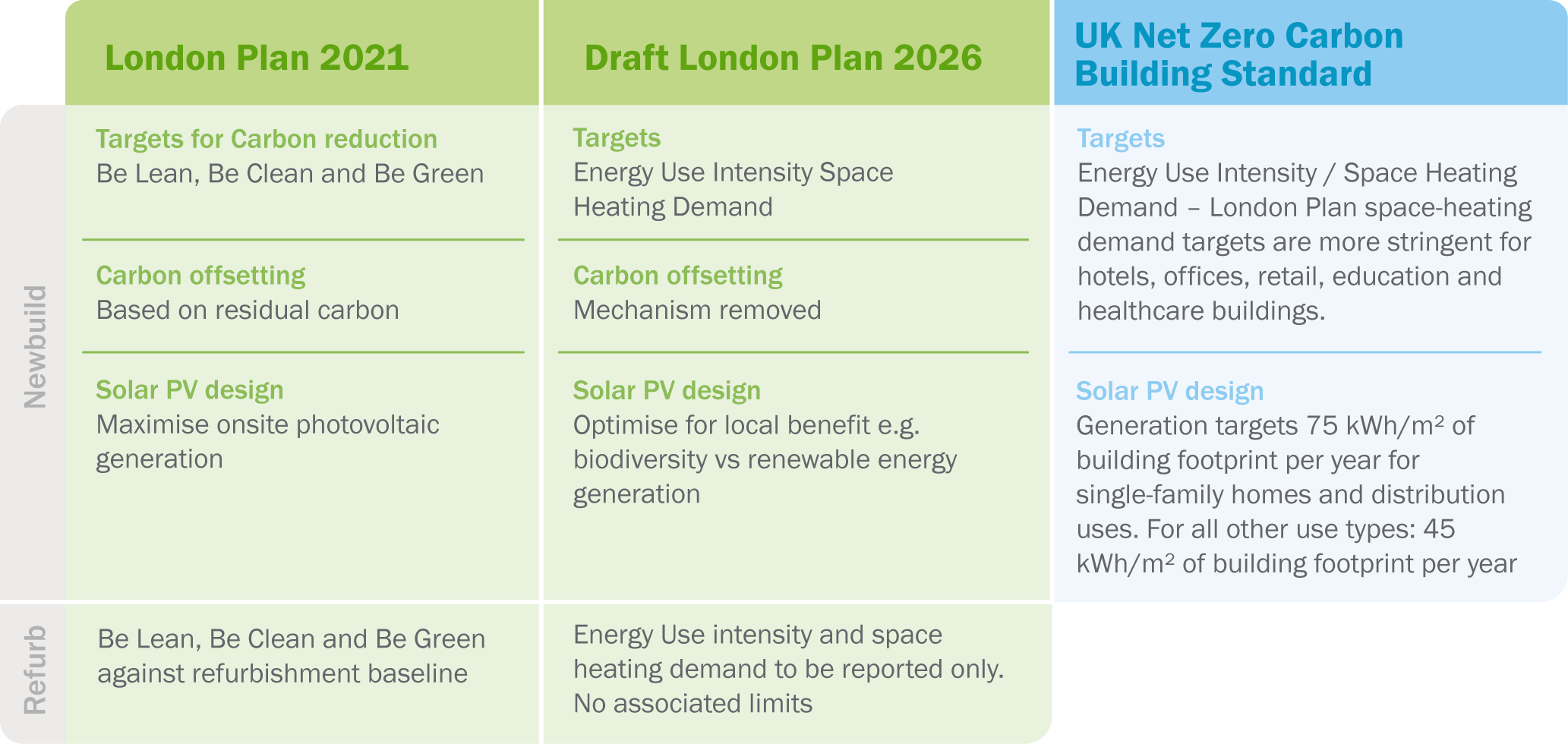
Before delving into the detail, it is important to note that the Draft London Plan has removed the carbon offsetting mechanism. This often represented a significant additional cost for developments across London.
The draft London Plan justifies the removal of the mechanism by referencing the National Planning Policy Framework’s aims to “streamline planning and reduce complexities” while “avoiding a multiplicity of separate standards and a ratcheting up of requirements and costs on development”. In its place, the draft London Plan proposes a more streamlined approach to energy and carbon, focusing on improving energy efficiency and reducing energy demand at source.
Energy
The 2026 plan improves consistency, but for energy only
The consultation draft seeks to centralise energy-related targets and performance thresholds across London, reducing the scope for plan-making authorities to diverge from a consistent city-wide standard. However, the standardisation provisions are referenced only within Policy GHR1. As currently drafted, this may leave scope for local planning authorities to introduce bespoke requirements relating to embodied carbon, circular economy statements, and performance benchmarking, potentially resulting in some variation in planning expectations across boroughs.
Energy targets have been refreshed in line with industry standards. However, the methodology is still unconfirmed, so it is unclear whether Part L can be used.
In place of carbon reduction percentages against a Part L baseline, the Draft London Plan introduces explicit Energy Use Intensity (EUI) and Space Heating Demand (SHD) targets for new developments (offices, residential, primary schools, hotel and student residential). For refurbishments and other usage types (e.g. life sciences), EUI and SHD values only need to be reported with no associated limits.
However, the methodology for demonstrating compliance has not yet been defined (updated guidance is due for issue at a later date). It is anticipated that performance-based energy modelling (TM54, NABERS and/or PHPP methodologies) will be required, aligning with the UKNZCBS approach. Whether Part L calculation can still be used is unconfirmed. If cannot be used, the complexity of energy modelling will increase, particularly for residential schemes.
Non-residential developments have been undertaking operational energy modelling for several years through the Be Seen requirements. However, the introduction of mandatory performance targets is likely to increase scrutiny of predicted energy use and reported outcomes.
For residential schemes, this would represent a substantial departure from the current reliance on compliance-based calculations, requiring operational performance to be considered as a core design parameter from the outset.
Solar panels vs biodiversity vs amenities
GLA referable applications are currently expected to maximise rooftop PV provision, with bio-solar solutions encouraged where green roofs constrain available roof space. The draft London Plan introduces greater flexibility to optimise designs for overall benefit. Where measures cannot be co-located, priority should be given to solutions delivering the greatest local benefit, such as biodiversity-led green roofs or PV systems that directly benefit building occupiers.
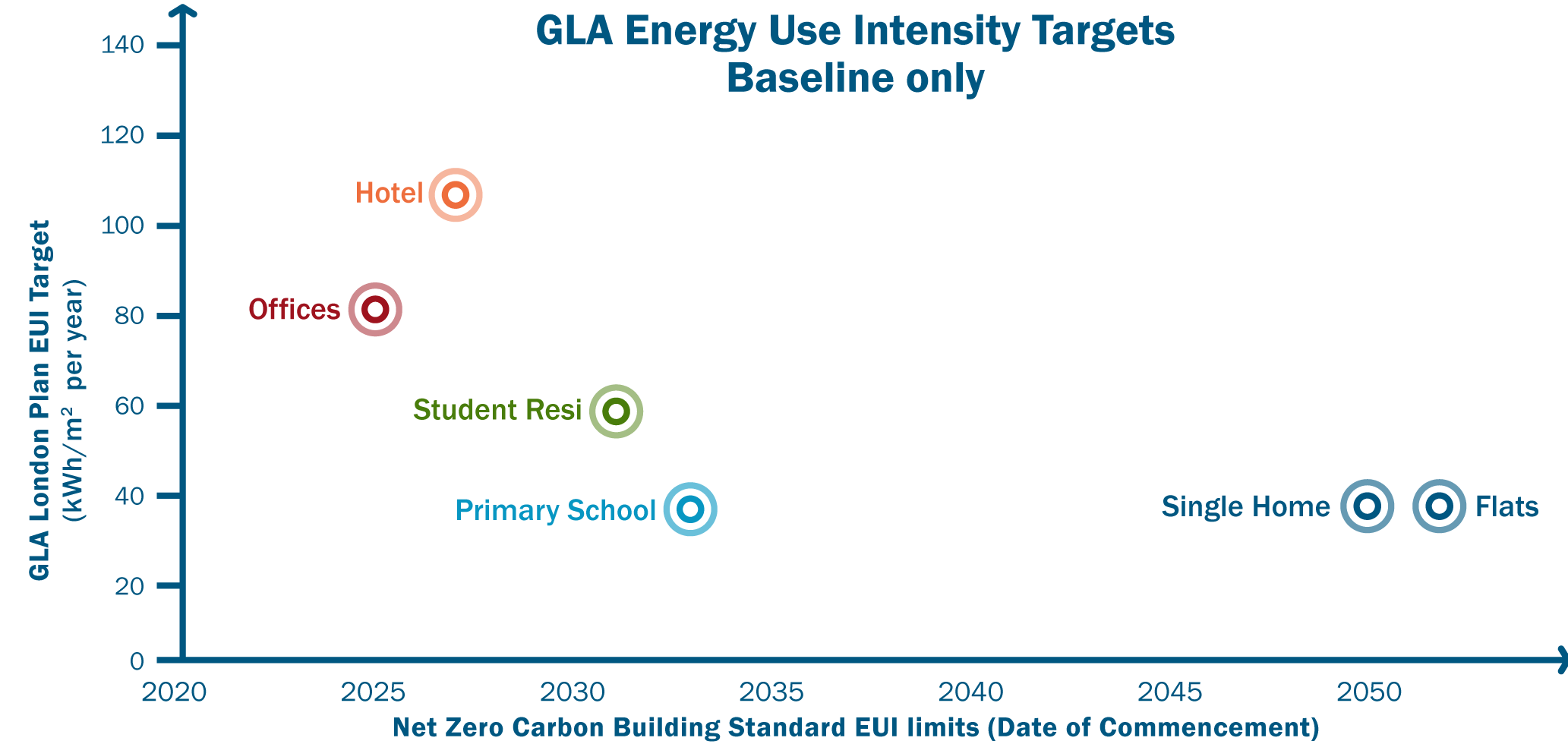
How does GLA’s London plan compare to UK NZCBS EUI limits?
For most building types, the GLA’s proposed baseline EUI targets fall between the UKNZCBS 2025 and 2033 targets. Residential developments are a clear outlier, with the draft London Plan target for houses aligning with the UKNZCBS 2050 target and the target for flats exceeding the UKNZCBS 2050 level of ambition.
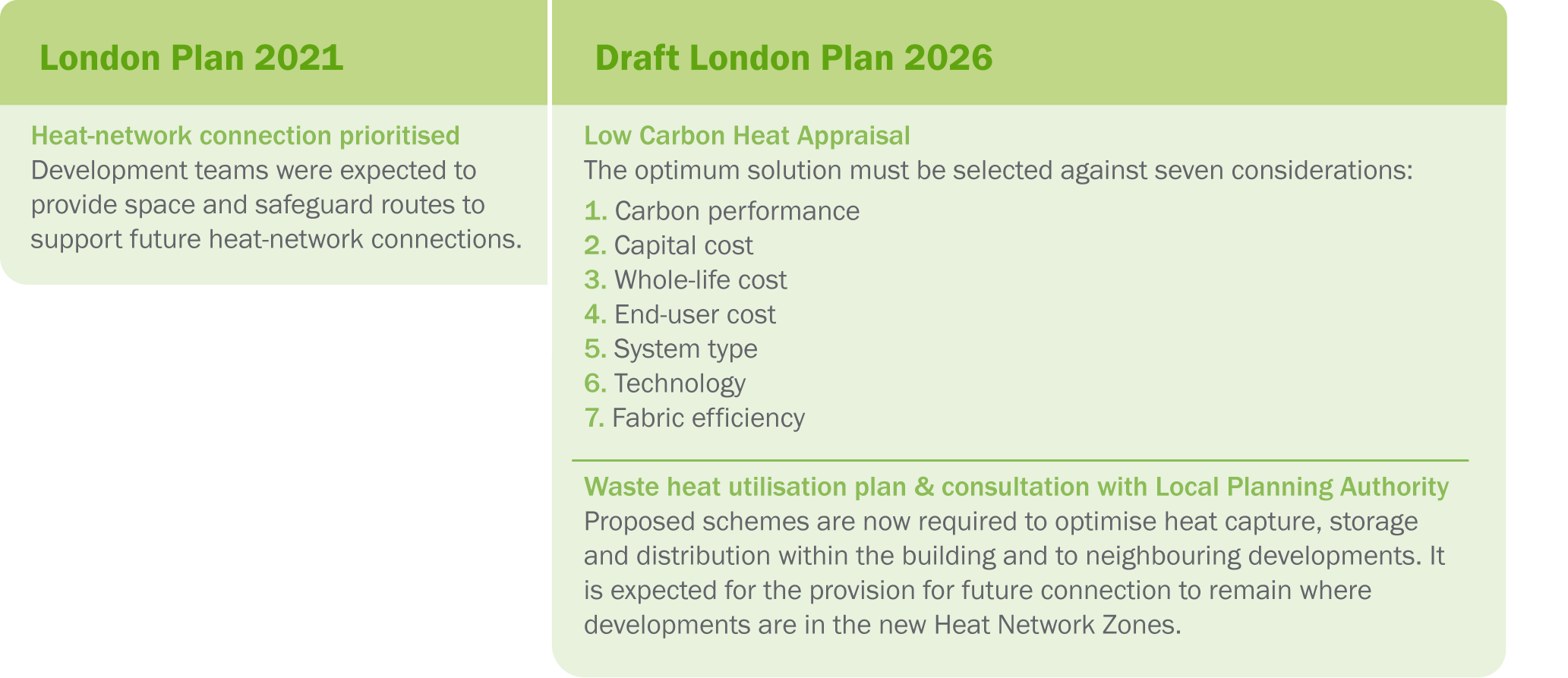
District heat policy shifting from network first to outcome-led appraisal
The 2021 London Plan prioritised connection to existing or planned heat networks as the preferred route to heat decarbonisation. In contrast, the draft London Plan 2026 replaces this approach with a broader Low Carbon Heat Appraisal. A dedicated appraisal template will be developed to support a consistent and transparent assessment process, enabling a level playing field comparison across a range of criteria, including those outlined below.
However, it remains unclear how robustly all seven considerations can be assessed at the early design stages, potentially adding a further layer of complexity to an already demanding planning application process. Developments with waste heat generation (e.g. data centres) are now required to engage with local planning authorities and evaluate the suitability of waste heat supply to existing or future heat networks.
Embodied carbon & circularity
Embodied carbon limits introduced
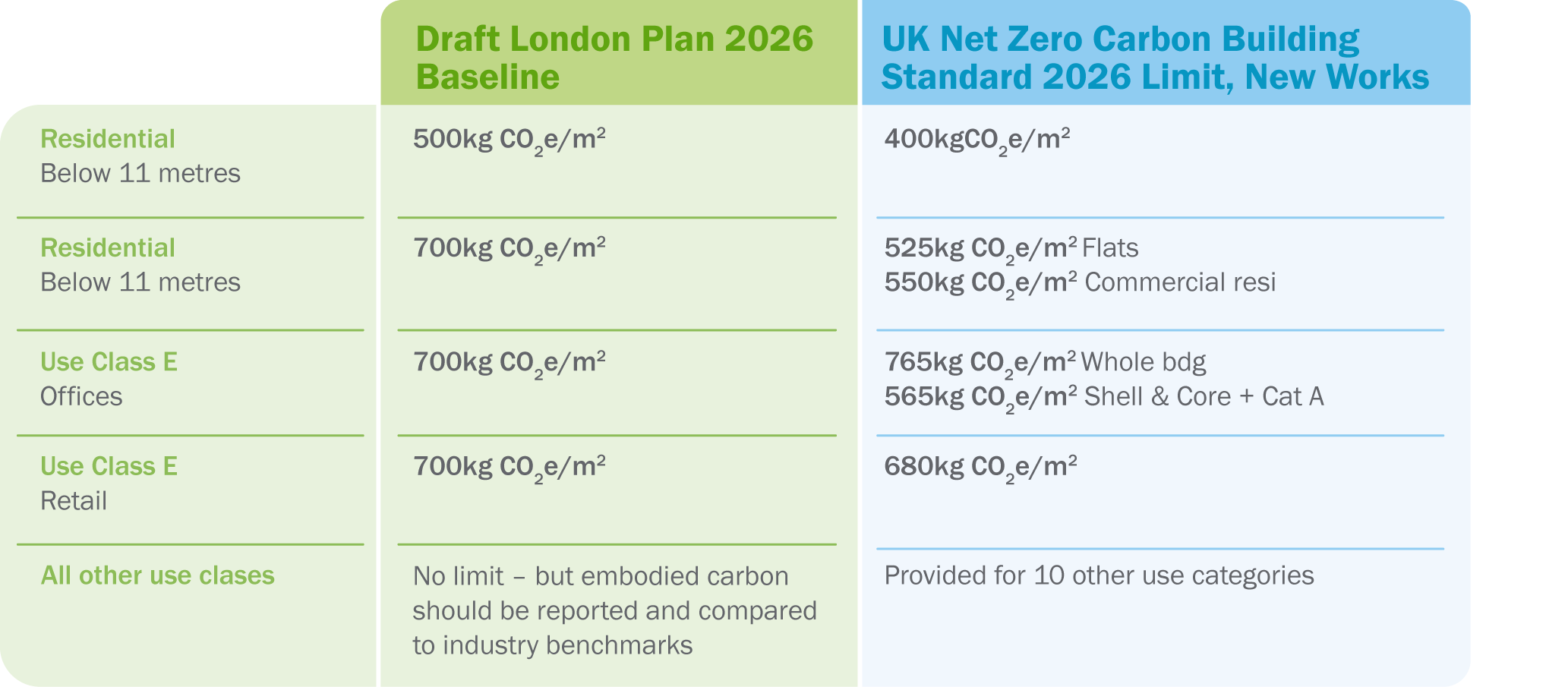
The draft London Plan introduces upfront embodied carbon limits which will be applicable to most commercial and residential developments. While these limits are less stringent than equivalent 2026 limits in the UK Net Zero Carbon Building Standard, they represent a significant step forward.
At present, we routinely see commercial projects exceeding the proposed limit of 700 kgCO₂e/m². To meet these targets, retention, early-stage carbon-oriented optioneering, design optimisation and procurement considerations will assume increased importance.
No major changes to Circular Economy policy
Requirements for circular economy outcomes remain largely qualitative as in the previous plan, and the same quantitative targets for waste diversion are retained.
While the GLA had commissioned a 2025 study to compare several circular economy metrics, the 2026 draft has not adopted one, given that none of the extant metrics met all criteria.
The 2026 draft clarifies that the requirement for 20% reused and recycled content is now mandatory and has the same level of applicability as the waste diversion targets, which was previously ambiguous in the 2021 GLA Circular Economy Statement guidance.
Thermal comfort
Thermal comfort (overheating) assessments are expected to become more extensive, with planning approval contingent on demonstrating that passive measures have been maximised.
Currently, proposed developments are required to demonstrate that overheating criteria can be satisfied through passive measures alone (excluding acoustics and/or air quality considerations) before the inclusion of active cooling.
The draft London Plan states that developments should demonstrate how the design has maximised passive overheating mitigation measures for both current and future weather scenarios. While the draft London Plan provides limited detail on what constitutes “maximised”, this represents a subtle but important shift in design approach. Rather than simply identifying the minimum package of measures required to achieve compliance, project teams may need to demonstrate that the full range of feasible passive design strategies has been considered and optimised.
Furthermore, to ensure that these measures are maintained through detailed design and construction, the draft London Plan suggests that “conditions should be used to secure these strategies and features where appropriate”. This could increase scrutiny during the post-planning phase and place greater emphasis on evidencing that passive design measures identified at planning stage are ultimately delivered on site.
Note: While CIBSE TM59 is referenced, the applicable version is not specified. It is anticipated that compliance will be required with the updated TM59:2026 methodology.
External thermal comfort criteria introduced for public and communal spaces
A new requirement is the incorporation of overheating mitigation measures within the external public realm and communal spaces, such as rooftop terraces.
These measures must be demonstrated at planning stage and secured through planning conditions. Proposed interventions may include:
- Shaded areas
- Green infrastructure
- Water features and other cooling measures designed to mitigate the urban heat island effect/li>
However, the draft London Plan does not set out a methodology for assessing or quantifying the effectiveness of these measures, nor does it define how mitigation of urban heat island impacts should be demonstrated. This may create uncertainty around assessment requirements and the evidence needed to support planning applications.
Impacts
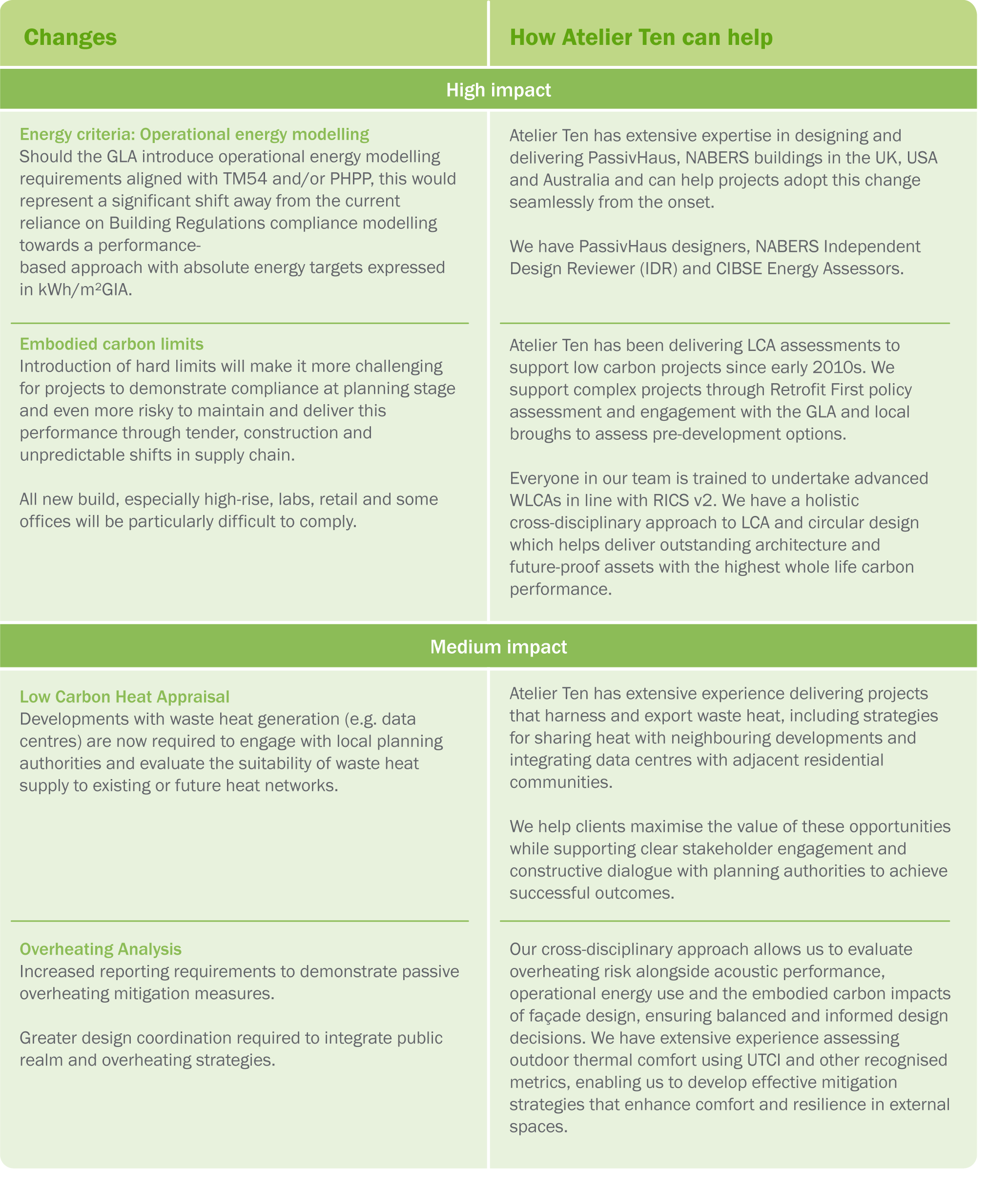
Next steps
How will the draft London Plan impact projects, appointments and programme?
It should be noted that the draft London Plan is currently under consultation and does not yet form part of adopted planning policy. However, the draft London Plan will be used to assess new applications against its requirements as a material consideration. Robust justifications will be required where shortfall against draft policy guidance exist.
For further information, please contact:
Younha Rhee, Director, Sustainability and Environmental Design – younha.rhee@atelierten.com