
Reimagining Transportation for People and Planet
The transportation and aviation industry is in a period of profound transformation. As airports and transit hubs respond to shifting patterns of travel, new operational demands, and accelerating climate targets, the design brief has expanded beyond moving people efficiently. These spaces must balance experience, performance, resilience, and identity to create dynamic, low carbon environments that support human wellbeing, long term environmental responsibility and bring the joy back to travel.
Below, Atelier Ten’s US transportation leads, Kristen DiStefano and Ben Shepherd, outline the major trends that are guiding the future of sustainable design for aviation and transit hubs.
Rethinking Atmosphere: creating a dynamic experience
Airports & Transit hubs are shifting from one size fits all environments to spaces that are intentionally designed for variable human experiences.
The spaces can offer a spectrum of sensory conditions: brighter vs. dimmer spaces, indoor / outdoor transition zones, daylight driven wayfinding, and comfortable outdoor areas that connect passengers with the outdoors. New human-centered approaches to modelling are enabling designers to understand and craft the visual and thermal experience that people feel as they move through a terminal.
By integrating experiential data early in the design process, these terminal spaces can be shaped as dynamic spaces that respond to both transitory traveler preferences and the long-term wellbeing of employees who inhabit them every day.
Rendering Courtesy of City of Chicago
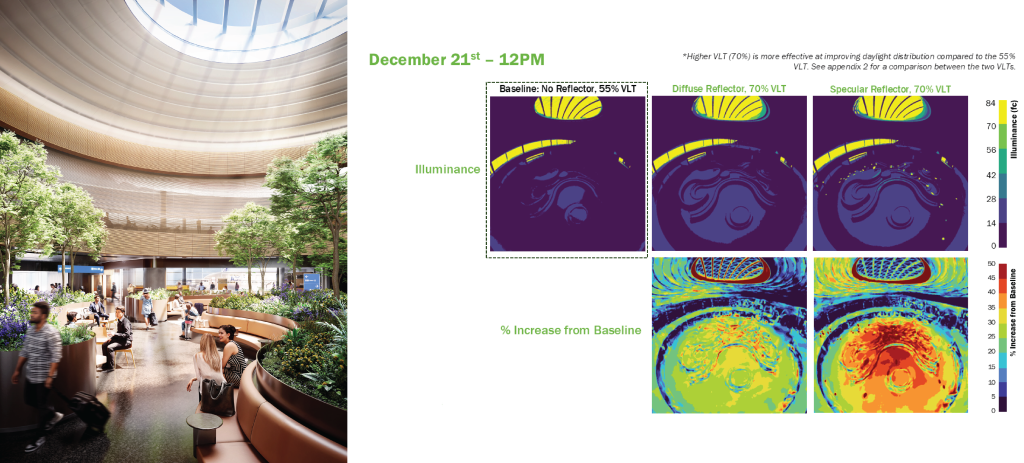
Case study: Chicago O’Hare International Airport Concourse D
As the largest expansion in the O’Hare airport’s history, Concourse D, designed by Skidmore, Owing and Merrell, will play a critical role in enhancing future passenger experience. Designed to allow over 90% of occupied areas to operate without electrical lighting during the day, the soaring, double-height concourse fills the terminal with natural light, and improves the passenger experience and connection to place. Atelier Ten’s extensive daylight modeling informed the unique roof geometry, skylight aperture, and façade design to maximize daylight while minimizing unwanted solar heat gain.
Biophilia is the New Amenity
Airports are reinvesting in the power of nature.
Natural materials, daylight, vegetation, and sensory comfort aren’t luxuries; they are essential to reducing stress, elevating mood, and bringing back the pleasure of travel. Because airports are also workplaces, these nature driven strategies serve a dual purpose: creating destinations where travelers want to linger, and shaping healthier, enjoyable environments for the people who keep the whole operation running.
The next frontier? Infusing biophilia with regional specificity. By showcasing local ecologies, materials, and cultural cues, terminals can deliver an authentic experience that reflects local character and provides a strong sense of place.

Rendering Courtesy of Zaha Hadid Architects / COX Architecture
Case Study: Western Sydney Airport
Inspired by the local Cumberland Plaine and shaped through collaboration with local Dharug Custodians, Australia’s newest airport is grounded in place. The design prioritizes passenger comfort and ease of movement, with an emphasis on intuitive wayfinding, reduced walking distances, and minimized stress throughout the airport journey. Atelier Ten worked with Zaha Hadid Architects and COX Architects to define the sustainability vision during the competition phase and played a key role in drawing in the Great Australian Light. The expansive timber ceilings echo sunlight passing through eucalyptus tree canopy and intuitively guide passengers through the terminal.
Enabling the Energy Transition
Airports are powerful players in the energy transition. While airlines and aircraft manufacturers must ultimately unlock the next leap in flight decarbonization, airports can lead on the areas within their control: efficient buildings, on-site renewable generation, electrified fleets, and future ready infrastructure.
As buildings, vehicle fleets, and even short haul aircraft shift from fossil fuels to electric, airports must be designed for increasing electricity demands and emerging technologies. This transition can only be unlocked with attention to energy efficiency, smart controls, and on-site renewable production and storage. With the right planning these shifts can cut emissions, improve resilience and reduce long-term operational costs.
Airports are critical partners in aviation’s path to decarbonization: alone, they can’t decarbonize the skies, but they can reinvent the ground game.
Photography: James Ewing
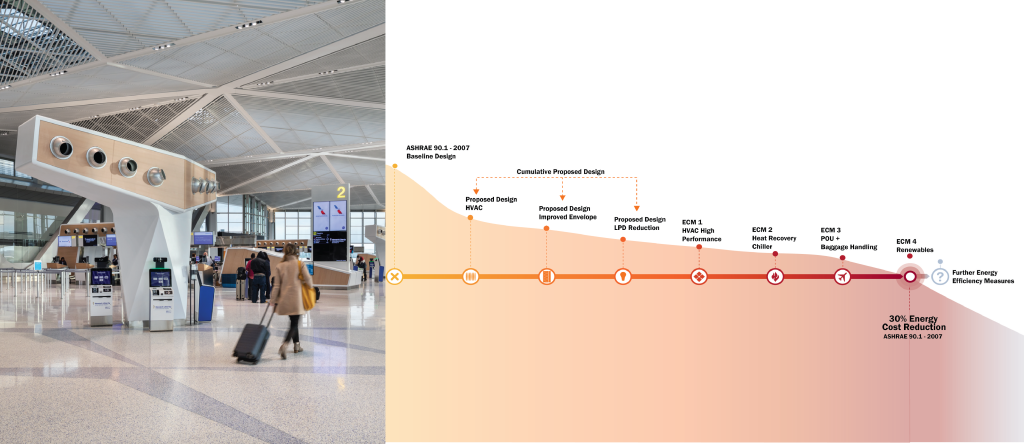
Case Study: Newark Liberty International Airport Terminal One
Atelier Ten’s comprehensive building performance energy modeling predicted a 33% energy savings relative to the ASHRAE standard for the new Newark Terminal One. Innovative solutions like demand control ventilation, energy efficient motors and belts for the baggage handling system, and efficient auxiliary power units at the departure gates, helped to reduce the equipment loads that were a primary driver for energy consumption.
Getting Serious About Circularity
Airports and transit agencies manage large portfolios with constant renovations and frequent expansions. That scale creates a major embodied carbon burden—but also a powerful opportunity for reuse and circular design. The fastest way to cut carbon isn’t through marginally better materials; it’s through strategic reuse of buildings, systems, and components. That means treating existing assets as carbon banks: evaluating every project for reuse potential and designing new buildings for flexibility, expansion, and second life use.
But circularity can’t survive as a vague idea tossed out in early design meetings. It must be project specific and championed within each phase. Iterative carbon modeling can identify embodied carbon hotspots, while circularity plans lay out the exact strategies that fit the project’s needs. Material circularity is not yet business-as-usual, so this is one area where even small reuse opportunities can have large industry impact.
Ultimately, the most successful projects are the ones that maximize what’s already built and embed circular thinking into every decision from day one.
Photography: Dave Burk & Aaron Fedor
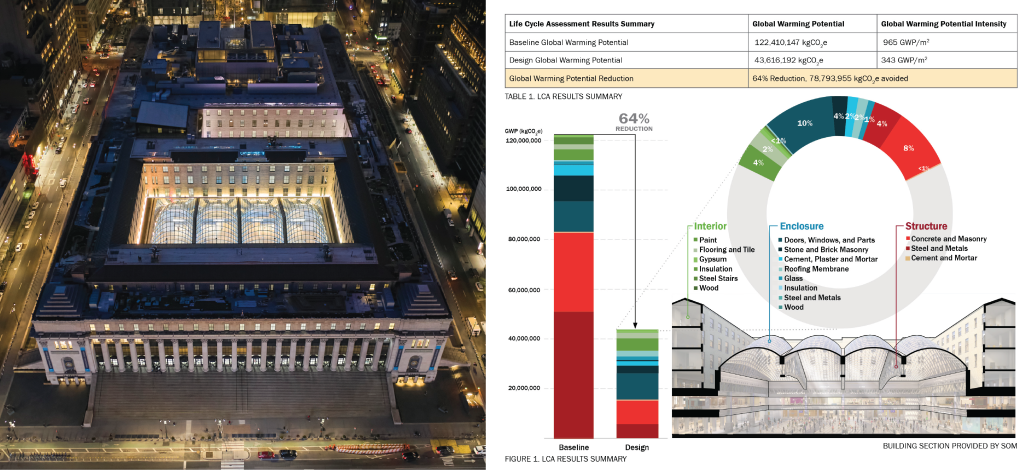
Case Study: Moynihan Train Hall
The renovation of the James A. Farley Post Office Building into the Moynihan Train Hall provided a unique opportunity to avoid embodied carbon emissions by reusing an existing, landmarked building as opposed to building a ground-up new development. By keeping much of the existing steel-framed and concrete superstructure – built in the early 1900’s – intact, the building demonstrates over a 60% reduction in embodied carbon emissions compared to a ground-up development. This adaptive reuse project saved 86,800 tons of CO2e, demonstrating the value of renovation and retrofit over new construction. Through Life Cycle Analysis, Atelier Ten modeled the project’s embodied carbon to determine the environmental impact of the adaptive reuse.